


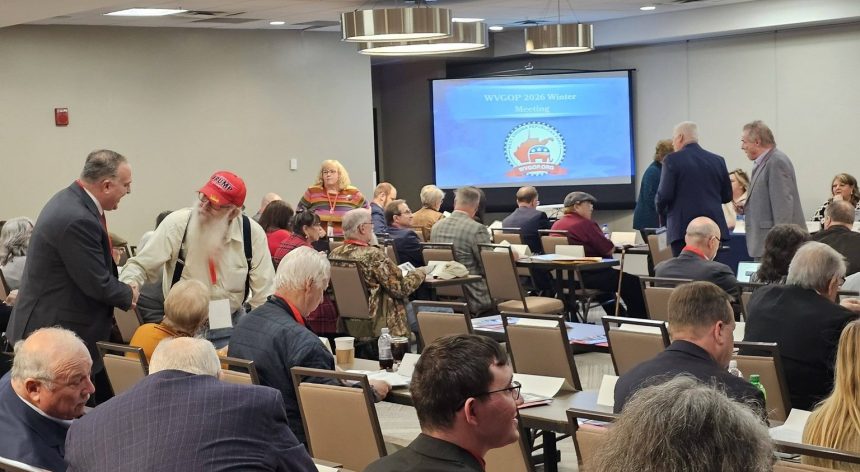
CHARLESTON — An effort to reopen the West Virginia Republican Party’s closed primaries for the 2026 election failed Saturday after a contentious State Executive Committee meeting marked by procedural challenges, disputed committee appointments and vocal objections from party members.
The meeting, held Saturday, January 10, followed earlier action by the party’s resolutions committee, which met January 2 to review four proposed resolutions.
Two of those measures, Resolution 6 and Resolution 7, were approved and forwarded to the full committee, according to Wes Parry, chairman of the resolutions committee.
The remaining two resolutions sought to reopen the GOP primary to unaffiliated voters. Parry said those proposals were combined and rejected in committee.
“The other two offered resolutions were both requesting a reopening of the primary, so the motion was made and carried to consider them as a single resolution, as they were asking the same thing,” Parry said. “The vote was taken, and that resolution did not pass committee.”
Parry said a minority of committee members attempted to force the issue to the floor through a minority report.
“However, the minority vote on the committee has offered an amendment to this report to force passage of that resolution out of committee to the entire SEC,” Parry said. “In defense of the resolution committee’s work and the effort to put into all resolutions, I would urge that we reject this motion.”
Questions quickly arose over whether the minority report met the requirements of party bylaws.
During the meeting, committee member Gary Dungan raised a point of inquiry, noting that bylaws prohibit amendments from the floor unless at least one-third of the resolutions committee submits a written petition to the secretary at least one hour before the meeting.
“For transparency we should know the members of the resolutions committee that petitioned the secretary and the time and date that the petition was made,” Dungan said.
“Yes sir, absolutely,” state GOP Chairman Josh Holstein responded. “We can do that now.”
Holstein said three members [Dr. Liz Balt, Nathaniel Mason and Rick Modesitt] submitted the amendment, which was received January 7 at 4 p.m.
“The bylaws also say that should any member of this committee vacate their position on this committee, the state chair shall appoint a replacement who is an executive committee member from that same congressional district,” Dungan said. He noted that Holstein and two others who left the committee were from the 1st Congressional District, while the three replacements were all from the 2nd District.
“So, they are not members of the resolution committee in good standing,” Dungan said. “And this motion is out of order.”
“I believe in consultation with the parliamentarian it may be correct that at least one member was not properly done, and that would be my mistake,” Holstein said. “That must be an error on my fault with the appointments, and I apologize for that.”
The parliamentarian confirmed the minority report could not proceed. As a result, the attempt to force the resolution reopening the primaries to the floor was ruled improper. All three disputed appointees had supported open primaries.
Following that ruling, another motion was introduced by Ken Reed to rescind the party’s prior decision, adopted at the 2024 Winter Meeting by secret ballot, to keep the 2026 Republican primary closed.
Holstein said the motion would require either a two-thirds vote of those present or a majority of the entire committee.
“Unless there is objection, we will limit debate to 30 minutes, three minutes per speaker,” Holstein said.
State Sen. Jay Taylor then moved to postpone the motion indefinitely.
“So if you want to continue a discussion on re-opening the primaries you would vote no,” Holstein said. “If you do not want to continue that discussion, you would vote yes.”
Attempts to require a roll call vote and a secret ballot were rejected by voice vote.
When the question was put to the committee, a loud chorus of “aye” votes supported indefinite postponement, while opposition was noticeably quieter.
“The ayes appear to have it,” Holstein said, prompting cheers and applause from much of the room.
A brief attempt to reopen the vote by Holstein led to shouting from the floor, after which Holstein backed down.
“It’s already been decided. Nothing we can do about it,” he said.
Taylor then moved to adjourn. The motion passed, and Holstein struck the gavel.
The outcome leaves West Virginia Republicans with closed primaries for 2026 and lingering questions about party leadership, adherence to bylaws and internal governance.